In Conversation with a&o Kunsthalle
Tanja Heuchele
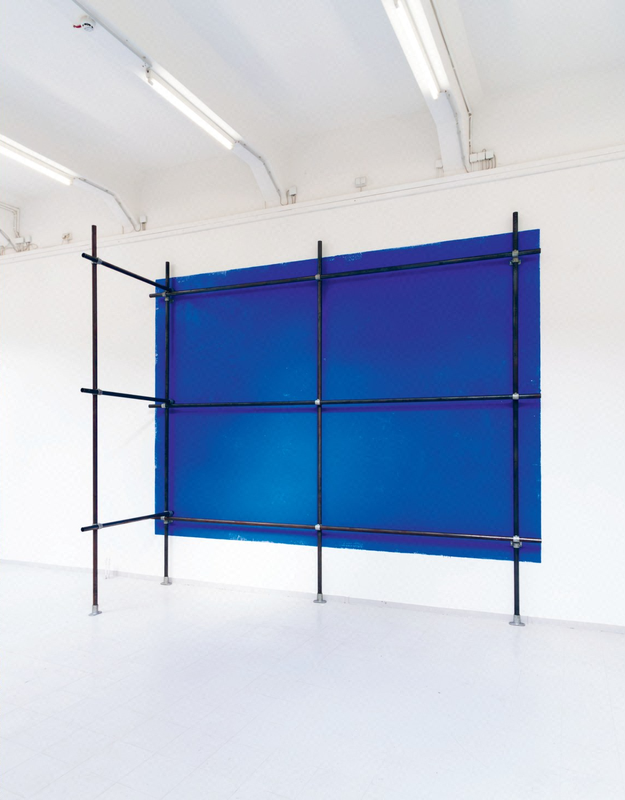
T: Dear Sebastian, how do you feel after this exhibition opening?
S: Good. I am pleased with what Luise, Franziska and I have achieved with the exhibition. I feel that we have created good situations and juxtapositions between the individual works, allowing them to come close and enter interesting dialogues. That does not automatically happen when you exhibit together.
T: In one of our preliminary conversations you spoke of an egoless group dynamic. How do you explain the ego taking precedence over the collective? Could we perhaps relate this phenomenon to Western culture?
S: Yes, I did. We are not a collective; the three of us curated ourselves, working in relation to the space and the content. I enjoyed the fact that we considered and respected one another’s work. We tried to gain something from the group situation, including for our own reflection on our work. Nothing would have been more boring than simply claiming space and showing our works separately. I am not a sociologist or philosopher who could classify or analytically contextualise this, but I believe it must be about showing respect and appreciation for the diversity of works and working methods, rather than merely presenting oneself or one’s own work. And yes, I would be glad if that happened more in our society. I believe we can also contribute our individuality when we compromise and create room for others.
T: One of your site-specific works is being shown in Bremen on a scale you have never presented before. How do you sleep before such a challenge, especially regarding its realisation? Are there dimensions you would rule out?
S: So far I am still sleeping well; that may change during the actual implementation. In my work I make sure it is appropriate to the place. It is not about size as such, but about where and in what situation a work is shown. In this case the size resulted from the dimensions of the plywood panels I use and the number of rooms in the Kunsthalle, since each panel represents one of the museum’s colour values.
T: As I have come to know you, you challenge and encourage the testing of boundaries, from painting to a conversation between two people. Black and white seems not a concept but an excuse. How do you see the so-called grey area?
S: Thank you for the question. Yes, many concepts for works arise from considerations of painting, front and back. These are problems inherent to painting that have occupied me since the beginning of my artistic practice. For me, grey does not inhabit a tension between black and white but exists as a colour in its own right, as the sum of all colours. That is why I assert colourfulness and diversity when I use grey. Black lacquer on a white exhibition wall is indeed a concept: it is the greatest possible contrast I can produce, giving colour a physical presence that is not dissolved by colour associations or symbolism.
T: As a professor, you are of course constantly in dialogue with emerging artists. What visions and wishes have you encountered in the new generations that have surprised you recently?
S: Above all, I see positive developments. I see much that I want to support and understand. I am curious. I am convinced that a way of working endures when it arises from a genuine interest or drive, whether biographical, activist or formal. I accompany and support this, trying to convey that neither one nor the other is better or more correct. A work concerned with content has just as much justification as a purely formal one.
T: As in many previous interviews, I would also like to ask whether you see yourself as an optimist or a pessimist, and why.
S: An interesting question. I think I tend to be optimistic. That is not to say setbacks do not affect me. I think I am good at imagining things. But I am not a dreamer: I want to realise things, to bring them into the world. Why? Is it an attitude? I do not know; I do not think you choose it.
T: Where do you see art’s greatest strength, especially in the visual arts?
S: I am convinced that art can open spaces of freedom and thought. In my understanding, an artwork is like a thesis, a proposition. It invites people to test that proposition and compare it with their own ideas or experiences. Art is a space of resonance; it lives through looking and encounter. I believe art should challenge rather than simply be consumable. The visual arts have the advantage of being able to stretch into any genre; techniques, attitudes and even historical periods are included. They can explain themselves, reveal how they came into being and how they were made, or refuse altogether and bring viewers to the limits of description. Language is often simply insufficient to grasp art; it has to be experienced and seen. At the same time, it is only an offer that artists make. I think that is wonderful.
T: What subject currently occupies you when you enter the studio? Is there a particular book you would like to share with us?
S: Chaos, at the moment! Haha. When you ask me about a book, an idea unfolds in my head: the studio as a retreat, with the possibility of picking up a book during breaks. My studio is more of a workshop where I prepare or follow up projects. I am not someone who produces a day’s output; I work in situ and towards specific exhibitions. When an opportunity arises to try something new, there is not really a subject, but rather the pleasure of being able to look and reflect. And the book: I have actually spent far too long reading How to Do Nothing by Jenny Odell. I think it is wonderful.
T: Thank you very much for your trust and the conversation!