Portrait
Rainer Beßling
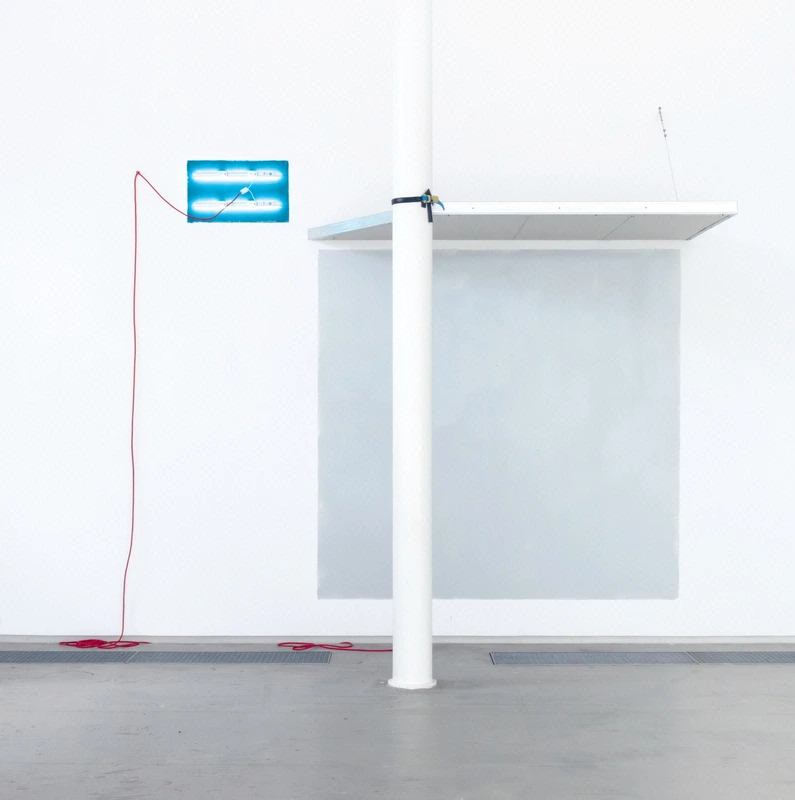
A canopy spans a grey monochrome. Applied to the wall with an airy, almost offhand touch, the painting brings out its surface texture. Beside and above the grey area lies a smaller petrol-blue field that, together with two fluorescent tubes, forms a relief of light. The light casts a shadow that cuts across the monochrome. The painterly gesture, with its irregular traces of application, and the non-art enamel in a colour favoured by architects already disrupt the colour field’s self-containment; the drawing made by light also brings real space into the painting. The canopy is fastened to a column with a bicycle inner tube and a tensioning strap. The handmade, imperfect connection between the two architectural elements extends the painting’s sculptural accompaniment and opens up a spatial situation in which viewers find themselves implicated. Depending on their position, the column’s shadow also inscribes itself into the coloured surface.
With his sheltered monochrome, Sebastian Dannenberg stages an interplay between interior and exterior architecture, between the inner worlds of images and their spatial relationships, in which perception plays an active part in bringing the spatial image into being. The artist calls his work at the Städtische Galerie Bremen “Meet me after Sunset”, introducing another layer of meaning. Alongside the somewhat absurd act of sheltering a colour field with a plasterboard façade element, and its tongue-in-cheek reference to pure painting’s traditional claims to autonomy, a narrative element comes into play. The association of meeting in a bar at dusk enters the formal and aesthetic proposition. Does painting’s liberation from the function of representation, a historic achievement of modernism, still urgently require protection? Or is it precisely the intrusion of lived reality into the image, through the shadow cast by the enclosing architecture and the imaginative impulse it offers, that reveals the fragility of the claim to autonomy?
Sebastian Dannenberg began his young artistic career, already marked by numerous awards, as a figurative painter working with the easel picture. He has remained with painting, with a painting that follows the tradition of establishing its aesthetic autonomy and expanding its boundaries. Having studied with Leni Hoffmann and Stephan Baumkötter, the artist takes up the expansion of the picture into an object and painting’s extension into space. The exhibition space is his studio; modular works are adapted to the architectural situation and the specific qualities of the site. Whereas he initially absorbed architecture and incorporated it into his easel paintings as settings for Hopper-like scenes, he now takes charge of the construction himself. What matters is no longer spatial effects within painting, but the effect of painting in space. In Dannenberg’s work, this effect is not merely staged: by being made transparent, it is also addressed and questioned. Not only has the mimetic function of reference been overcome; in the Bremen artist’s work, the separation of a field of observation distinct from the real world also appears to belong to history.
Alongside his canopies over monochromes, the first version of which was shown last year at Kunstverein MMIII in Mönchengladbach, Dannenberg explores another series combining painting with wooden frameworks propped against the wall in front of colour fields and typography. Here, the deconstruction of the easel picture becomes immediately tangible: the stretcher expands into a sculptural construction, while the wall replaces the canvas as the support for the image. The makeshift sculptures with which Dannenberg supports his painting serve several functions. They stage an ambiguous play of interchange and interconnection between the front and back of the picture. They play with the question of whether painting, or colour itself, requires support when it has enjoyed every freedom since its emancipation from the constraints of representation. At the same time, the constructed character of the image is emphasised. Its made quality appears in the form of a rather provisional framework. Rough-and-ready manual work is exposed in place of sophisticated technology, which usually conceals production behind smooth, flawless cladding.
This can be seen as a turn against the anonymisation of a technologically dominated everyday life, against the erasure of the manual trace that once attested to a shaping authorship. By displaying the framework, the image’s dominion within the realm of ideas is relativised. Rather than confronting the viewer with the image’s emphatic frontality at its surface, the work offers insight into the image’s constituent elements and its interplay with its context. Viewers can develop an understanding of its mechanics, its mechanisms of visual effect and its architectural conditions. The analytical gaze is sparked not by dry, earnest formalism, but by a playful, humorous destabilisation of the image’s identity, unfolding a rich range of dislocations and shifts of meaning.
In Dannenberg’s works, viewers do not look at an imaginary world behind the picture. Instead, they position themselves behind the picture within a real space of observation, bringing their experiences, perspectives and ways of seeing. Through the medial interface of painting, they are directed towards an outside world, towards which they orient themselves as they pass through a succession of art spaces. Spatial experience becomes experience as such: not a sequence of individual, static encounters with images, but a dynamic, sensory mode of observation that involves viewers in the image and beyond it through atmosphere, movement and bodily experience. The size of the works and their placement on the wall play an important role here: distance and proximity, and thus movement, are equally called upon.
Some frameworks seem to invite climbing. Some bands of colour cannot be grasped in a single glance, such as a “floor frieze” supported by paint cans and car jacks at the Heine-Haus in Lüneburg. Responding to the prohibition on nails and screws in the listed building, the artist introduces a second pictorial plane in correspondence with the ceiling, linking three rooms of the historic residence. In a work for Cologne’s Vorgebirgspark, painting quite literally gets in the way: a twenty-metre-long, table-like construction bearing a red brushstroke responds to the architectural situation and mediates between two levels, while simultaneously breaking the park’s symmetry and disrupting habitual routes. Painting appears here as pure proclamation. On its own display structure, it inserts itself among the local and situational conditions, aligns itself with them and frees itself from them, crosses the paths and habits of those it addresses, and points to its own physical presence.
Dannenberg’s typographic works have the most pronounced figurative character within his practice. They carry a distinct signifying function, which is nevertheless counteracted by their monumentalisation and materialisation, by the intensified presence of the sign as a physical body. The decision to use a word such as “JET” in another work for the Mönchengladbach Kunstverein was purely formal: the designated wall had to be filled with a word in a four-to-three ratio. It was to have a dynamic sound; a steel construction with fans in the upper part of the room provided the impetus. By stripping away the signifying meaning attached to the object and replacing it with the object’s sheer presence and its space-producing relationship to the observer, Dannenberg’s spatial art makes space itself the medium. Despite its reach into space and its sculptural escort, Sebastian Dannenberg’s practice comes together in painting; painting is where the work culminates. Painting is the fundamental condition of all his works. The sculptural elements serve the coloured surface, which in turn allows space to be experienced anew. This is neither an inward-looking examination of the conditions of painting nor an attempt to occupy space and place through sculptural painting so completely that meaning and function are entirely transformed. Rather, it is about differentiating pictorial spaces and spatial images and setting them in motion through one another.
Dannenberg’s works affirm painting’s standing as an indispensable medium for exploring and appropriating the world through acts of shaping. The artist professes the greatest respect for the moment of applying paint. His painterly interventions are an emphatically formative, individual, creative and poetic gesture, authentic and bodily, yet they do not amount to a reverential exaltation of the artistic act. The dissolution of the static image and the painterly act as an individual gesture are made transparent through a casual indication of the picture’s format that leaves room for play. The artist does not relinquish painting’s autonomy, but by unfolding the elements of the picture he creates a flexible apparatus in which conceptual attributions, social interactions and ordering gestures can develop, and in which lived experience can be grasped and described.
Successful images have, of course, always opened up new horizons of perception and understanding. What is crucial to Dannenberg’s strategy, however, is that it takes seriously the medium’s power of assertion and persistence in its form and materiality, opening new avenues of access through shifts of position and changes of function. Dannenberg carries these formations forward both as things that have been formed and as interrelated structures. Opening them up fractures the identity of the work; the resulting dislocation heightens attention and prompts reorientation, allowing for a wide variety of approaches, perspectives and positions. Rather than being placed in front of a work, viewers are set on a path by the processual character, dynamism and event-like nature of the spatial work.
In a series entitled “aircondition”, the functional architectural element of a ventilation system is evoked alongside the decorative architectural element of the frieze. Behind metal panels, colour fields lie on the wall, visible around the edges, through holes in the covering and beneath a panel that has been lifted up. To realise the work, Dannenberg uses shelves from a heavy-duty storage unit in his studio. The readymade is archetypal and readily recognisable, yet repurposed through its vertical use. The work plays with concealment and revelation, presence and absence, and the pull and attraction of what is hidden. It relies on the logic of completing a sequence through knowledge of the characteristics of one of its components.
A field of tension emerges between the openness of the work and the viewer’s need to bring this unstable configuration, steeped in the poetry of the provisional, into an order, a structured relationship. At the Bundeskunsthalle in Bonn, the artist places a band of green paint on the wall in the shape of an angle with a rounded corner. On the floor, a low sculptural construction traces half a quadrilateral, likewise with rounded edges. Painting and sculptural form occupy different planes, horizontal and vertical, far apart from one another, yet they come together in the viewer’s gaze.
Precisely through their rejection of wholeness and closure, the works activate their viewers’ need for unity and identity. Missing parts, gaps, absences and deviations call for imaginative completion, for the addition of the omitted elements. Looking draws upon experience to translate the structural principle, set out only in fragments, into a manifest relationship.
Sebastian Dannenberg’s position takes up the logic of painting’s development, playfully and critically questioning its claim to autonomy and intersecting the White Cube’s lofty postulate of seclusion with actual space and lived reality. Rather than reaching for the historical instruments of media and institutional critique, he raises, in a post-ideological spirit, with a light touch and a whimsical gesture that remain formally precise and pointed, the question of art’s place, location and space. He asks how viewers can be activated within a situation to construct aesthetic space as a model for a liberated and enhanced capacity for perception in social space.