For Edward and Blinky
Leon Hösl
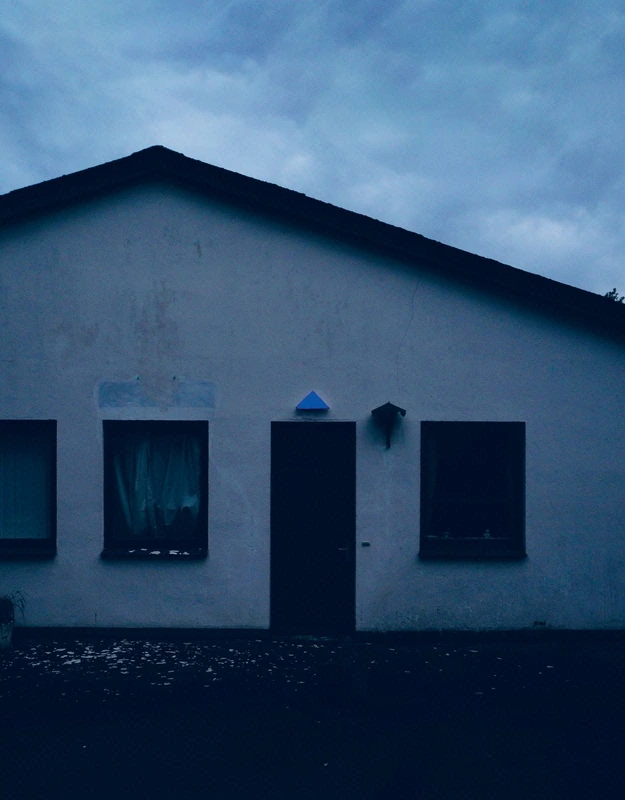
A slightly run-down, unremarkable building facade, shops on the ground floor, the dark night sky in the background, just after the blue hour, before it gets truly dark but long after the sparsely placed streetlights have been switched on; the pavement and street in front of the building are deserted. With its American inflection, this could almost be a classic Edward Hopper scene, were it not for a small blue triangle glowing above the entrance at the centre of the image.
Sebastian Dannenberg repeats this intervention in nocturnal cityscapes in different locations, producing the ongoing photographic series “for blinky”. In 1969, this Blinky painted a blue triangle on paper, which was sold with a matching stencil, a tube of paint and a brush. The buyer was to use the stencil to paint a blue triangle above a door and then pass on the original sheet. Dannenberg has reversed this concept, through which the German painter Blinky Palermo plays with authorship and appropriation: he adorns entrances at night with his illuminated triangle and captures the moment with such atmosphere that Edward Hopper, too, would be delighted. The partly photographic, partly installation-based conjunction of two entirely contrasting artistic personalities works with surprising harmony in this series. It is almost emblematic of Sebastian Dannenberg’s practice.
This year, in the exhibition “upper” at GADEWE in Bremen, Dannenberg painted a black field in the shape of an elongated trapezoid directly onto the exhibition wall using lacquer. It follows the room’s existing corner, making a right-angled turn. The reference to Constructivist painting is unmistakable, and there is also a hint of Palermo’s wall painting. What differs, however, is the strongly painterly brushwork and the traces of paint that break out of the geometry under the force of gravity. And, of course, the wooden construction is disconcerting: it obstructs the view of the painting and, suggesting a supporting function, recalls the braces of a billboard.
This wooden structure, assigned the absurd task of stabilising a field of paint on a wall, allows the work, titled “somewhere far”, to be considered from two perspectives that depend on one another and cannot be clearly separated. On the one hand, its representational character takes centre stage: associations with billboards insistently arise, spectacularly mounted on rooftops as they have been in many a film setting. Yet the non-representational, autonomous aspect carries no less weight. The abstract field of colour emphasises the work’s self-referentiality, while the materiality displayed by the timber might point to the missing support of paint applied directly to the wall. Both levels resonate and connect, allowing Dannenberg to affirm the autonomy of painting while simultaneously referring to its representational background.
In virtually all the works that offer an insight into Sebastian Dannenberg’s practice over the past two years in this catalogue, the display side conceals more than it reveals and seems to deny viewers the principal view. Take “kick flip”: the slightly transparent canvas offers only a blurred view of the wall painting behind it. Or “formal green – the interlude”: a rectangular field of colour, again applied directly to the wall, is almost entirely covered by white wooden panels; the green shows through only in the gaps. “last exit for 67 miles”: another billboard showing us its reverse and keeping its information to itself. Finally, “lucy”, made in collaboration with Kriz Olbricht, covers the entire corner of an enormous concrete wall. Even in the typographic works, the mirrored letters must first be rearranged in the mind before they reveal their content. The works thus point to something happening behind the image, associatively opening up an imagined pictorial space like that created by central perspective in panel painting. Yet it also quickly becomes clear that the works withhold nothing: in this case, an apparent reverse is simultaneously the actual display side.
A work such as “somewhere far” thus acknowledges its place in the tradition of painting. It knows of its impending end, which it must try to defer by continuing “the reduction to its original essence”. At the same time, it insists on pointing out that, with painting’s non-representational autonomy, the narrative of pictorial space has also come to an end. What distinguishes Dannenberg’s position, however, is that it does not entirely erase illusionistic pictorial space. Instead, it skilfully suggests its possibility with a certain absurdity, allowing it to resonate as a reminiscence in the minds of viewers.
He thus alludes subtly to modern painting’s liberation from representation without becoming trapped into having to take a definitive position. He achieves a contemporary painterly balancing act between painting’s original illusionistic, depictive task and its modern autonomous status. For all its complexity and its formal and conceptual density, Sebastian Dannenberg’s art speaks an open, humorous language rooted in his pronounced fondness for the appeal of the provisional. His works therefore always have a light, almost incidental character, revealing their compositional wit only at a second or third glance. This wit arises from the interplay of stillness and movement, pictorial format, front and reverse, and the use of rough, unworked materials. That his art always encounters itself and its context with a good measure of irony, and that Dannenberg is not afraid to use catchy English slogans as titles, fits very well with his statement: “I like it intelligent, but not too serious.” This quotation speaks through all his works, enabling him to think about his medium from many sides without losing sight of its essence. For one thing is beyond question for Sebastian Dannenberg: “I am a painter.”