genre – three conversations
Janneke de Vries, Mona Schieren, Annett Reckert
Constructed Images
Janneke de Vries
J: Looking at your work, I would have assumed that you deliberately undermine the boundaries between genres and are not interested in categories such as painting, sculpture or architecture at all. Yet in your publication you consciously distinguish between them and make that distinction the basis of the conversations to which you have invited us curators. Was I so mistaken in my assessment of your practice? And are the sculptural, painterly and architectural aspects of what you do really underpinned by different approaches and ways of thinking?
S: Of course you are right; I do not want to limit myself either. People have often wanted to assign me to a particular genre. In principle, I do not mind, but I am interested in making distinctions because, over the past year, I have increasingly felt that the individual components of my work have a certain sequence and different priorities. I would like to explore these in our conversations. There will certainly be overlaps here and there; I am sure of that, and I hope so too.
J: I find that intriguing because it is unexpected. When you say that “the individual components of my work have a certain sequence and different priorities”, does “work” mean your practice as a whole or each individual piece? In other words, does this observation apply to your approach in general, and therefore equally to every work? Or is the sequence of sculptural, painterly and architectural aspects renegotiated in each work and different from project to project?
S: “Work” does mean my practice as a whole. Of course there are various “excursions”, such as Barbarastr. 14 or BEACH HOUSE. But I do not renegotiate this every time. The sculptural is usually subordinate to the painterly concern. I try to realise painterly propositions in my works. It is about painting in space, about painting that is supported or held … Sculpture is often a means to an end here: it is construction and material, which also bring qualities of their own. What matters to me is that the material remains recognisable and the action can be understood.
J: Was this approach, which is oriented towards painting but explicitly includes sculptural and architectural aspects in order to expand it, part of your artistic practice from the outset? And what does sculpture have that you feel painting lacks, or what can sculpture contribute to support your painting?
S: At the beginning of my studies I painted in a conventional way, somewhat “Hopper-like”, working with planes and painterly effects. I went out with a camera and made photographic sketches for paintings. At some point, however, I became bored with merely producing representations. So I took over the direction myself and incorporated architectural fragments that had fascinated me on my photographic excursions: illuminated signs, canopies, niches, markings, or the empty spaces between buildings; mostly banal or almost invisible things. For me, incorporating the sculptural and the material was, to some extent, a way of appropriating the world. It gave me the opportunity to move away from figuration and representation and into reality – with reservations, of course. Material, the real, is an entry ticket into my pictorial world and my understanding of painting.
J: You equate material with reality, whereas representational, figurative painting seems to stand in opposition to reality for you. Could you explain that a little further?
S: That is probably true. In my work I had grown tired of representations. I felt that every picture had already been painted and that I was unable to establish new pictorial inventions on canvas. At times it was agonising to be confined to the limited space, the mere surface of the canvas. I felt I was working against myself, holding myself back. Then something clicked, and everything became easier and more expansive. I had always enjoyed building and working with wood. So it was only logical to arrive at constructed images, at surfaces painted on the wall that extend into the room through wooden structures. It was liberating to think and work within this entirely new scope.
J: You describe Barbarastraße 14 and BEACH HOUSE as “excursions”. In what sense, and where to?
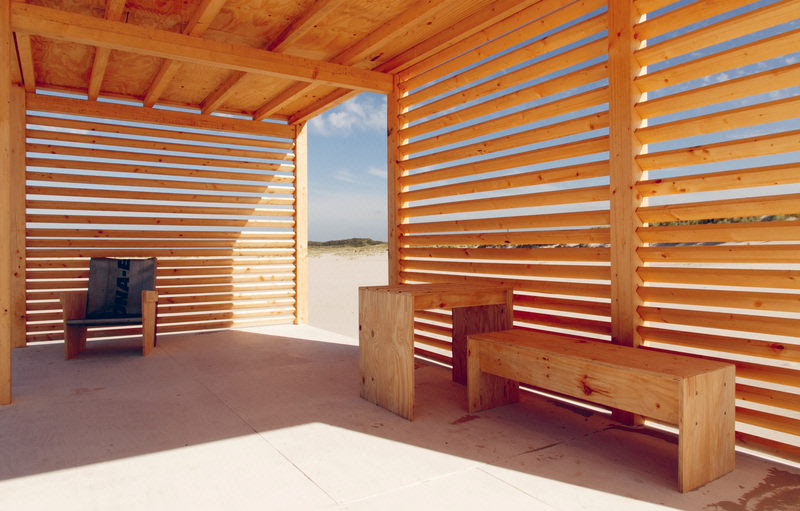
S: Excursions into distinctly architectural and sculptural contexts. I normally try to situate painting where it does not belong. In these two cases, the places called for something different. BEACH HOUSE did, however, originate in a painterly concern: it was an architectural situation for looking at the landscape, offering or suggesting a standpoint and directions of view, an invitation. The views to the sides of BEACH HOUSE were like predetermined picture formats, directing and framing the gaze. This wonderful spot called for a spatial reflection on the place, rather than a work that competed with it in terms of surface or composition. It was a reminder of urbanity in a place that cannot be built on or settled. The autumn storms would have swallowed BEACH HOUSE at the latest; instead it remains in memory as an ephemeral event, a setting full of longing and a longing to see. Afterwards, though, I realised that I am not a sculptor. Four and a half tonnes of material is quite a pile, and not easily moved. A short time later came Barbarastraße 14, a homage to my time in Freiburg with David Semper and Kriz Olbricht, whom I met during my studies: a very private architectural echo in public space. A low plinth that can be walked on, showing nothing except a form that recalls architecture. These two works were spaces of possibility and probably even more austere than the explicitly painterly works.
J: I would not describe BEACH HOUSE as austere, but as a precise and, in this context, intelligent engagement with habits of reception, precisely because it was unobtrusive. Viewers were involved. It was only through them that the place was defined. At the same time, the structure receded and gave precedence to the landscape. In fact, I experienced BEACH HOUSE then as a very contemporary form of landscape painting. Paintings such as Caspar David Friedrich’s Monk by the Sea or Emil Nolde’s seascapes were virtually present when you stood on the platform and looked out to sea. You painted there without even picking up paint or a brush. Instead you used the possibilities of a sculptural and architectural intervention and the viewers’ imagination as materials. That is why I see the work less as an excursion or exception than as an exact realisation of what you seem to hope for from sculpture within your artistic practice. Sculpture and painting meet here on equal terms, and sculpture brings a particular kind of painting into being. But if BEACH HOUSE is more of an exception for you, what would be a project in which you used sculpture to address painterly questions in a way you would consider consistent with your approach?
S: I am glad that this multilayered meaning emerged for you in your engagement with BEACH HOUSE. I often feel that the only things I can really control are the appearance, the character of the material, and the painting I carry out. Of course I thought of Caspar David Friedrich on that beach, but I can only let such associations inform the concept; I cannot expect them to arise for viewers. I would say that sculpture serves painting as a structure, allowing painting to happen in an entirely different way, expanded into space, beyond what the traditional format of a flat, rectangular painting support permits. This is often based on ideas such as extending painting across the floor or around the corners of buildings. The sculptural intervention should always be simple and basic, made of straightforward materials that do not dominate. At present, however, I am rethinking this. I increasingly come across readymades or raw materials that appeal to me greatly, and then consider how I might use them meaningfully. The starting point for a work can now also be a material or a found object. I also believe that my consistent approach, as you called it, naturally takes place within art. For me, this means that all the criteria and rules I set myself apply within a context of freedom, so that – within this framework – I am allowed to do anything. The attraction of being an artist lies in the diversity of the profession. It consists in defining fields of research for myself, which I can also adapt and change according to my current interests. But to return at last to your question about using sculptural elements to address painterly questions, I would name straight edge. The work was made in 2013 for a park in Cologne and has strong sculptural parameters. It consists of a wooden display twenty metres long and 1.30 metres high, folded along its length and coated with white exterior paint. straight edge exposes a single orange brushstroke. In this case I went to considerable, actually absurd, lengths to execute and present a single stroke of paint.
J: The subordinate role of the sculptural components in relation to painting becomes particularly clear in a series in which you place scaffold-like wooden structures in front of walls bearing monochrome colour fields or lettering, for example last exit for 67 miles, 2011, NO MORE SUNSET and somewhere far from 2013, colourmaster 3000 green from 2014, and JET and TRANSIT from 2015. Here you seem to support painting quite literally with a framework. Was that the idea?
S: The first work was made in 2011: green valley. The original impulse was to extend painting away from the wall and into the room. One motivation was my engagement at the time with the Suprematist tradition. But I was so intensely occupied with questions about the role and possibilities of painting that I could not yet really think about the sculptural. The colour field in green valley is not yet convincingly held by the wooden structure. It seems rather fragile and searches for a form in space. JET, realised four years later, is already quite forceful and asserts itself quite naturally through the coherent interplay of painted, reversed lettering and the massive supporting structure reaching out into real space – at least in my perception.
J: Would you agree that many of your works can be grouped into series? We have already discussed the “painting + framework” works. But there are also the “roofed” wall surfaces in monochrome grey that you have repeatedly installed since 2012: space saver, shop one, shop two, hot dog and candy shop. Here I would identify an approach similar to JET and its companions, in which the sculptural intervention does not support the painting but seems symbolically to protect it. Or the series in which the sculptural elements are freed from their more subordinate function and enter into a symbiosis through the combination of a coloured brushstroke on a sculptural component and the existing architectural situation, as exemplified by straight edge, 2013, auto reverse, colourmaster 3000 green and three fingers down from 2014, or deep down and dirty and loop from 2015. This raises one question: do you agree with my brief characterisations of these groups of works? And looking at these series, I also wonder when a pictorial and sculptural idea is finished for you. Or does that not happen? Do you instead keep returning to an idea, varying it whenever a spatial or local situation seems to offer an opportunity?
S: Yes, my works can be grouped into series. But I do not know whether my ideas will ever be finished or exhausted. One reason for these different approaches is simply that I do not want to get bored. If, for example, I have not made a typographic work for a long time, I feel the desire to make another. Of course I also return to older, tried-and-tested approaches. For me, the repertoire of my artistic possibilities is like a toolbox that has gradually filled up over the years and suits my needs. Nevertheless, I occasionally have to improvise, creating room for something new. Working in series is necessary to reinforce an aesthetic proposition through repetition and variation in different contexts.
J: You mentioned that your approach is currently changing in that readymades can now prompt a work and you then incorporate them. Was this the case, for example, with the blue tension straps in I stay while you go, 2013? Can you use that example to explain what found components must contain to interest you? Painterly qualities such as colour, perhaps? Or sculptural aspects such as form?
S: What matters is that the objects I use are clear and unambiguous: that a tension strap remains a tension strap and only acquires an additional charge at a second glance. One might describe this approach as a search for archaic qualities that an object must possess to become relevant to a work. Colour naturally plays a role, but not so strongly that I would spend weeks looking for a particular green strap. If I cannot find one, other aspects of the planned work may change; I might reconsider its colour concept.
J: Does incorporating readymades mean that your work becomes more independent of its particular location and is no longer so explicitly site-specific? And does this different treatment of sculptural aspects also entail a shift in content, a different view of sculptural, architectural or painterly meanings?
S: Essential to these changes and expansions are my contacts with the market, with galleries, which prompted me to think about movable, more manageable and therefore also saleable works. I now feel that this does not dilute the content of my work but has helped me find new solutions to problems inherent in it. You are right to point out that my work is no longer exclusively site-specific. Nevertheless, in every exhibition, with each individual work, I still have to get to grips with the actual room, by becoming clear about the structures, consonances and dissonances in the relationships between the works as I position them. I feel quite free to combine and coordinate movable and in-situ works. I am not sure whether this constitutes a shift in content, but I find it liberating to have both forms of work available and to be able to think about them.
J: Is sculpture sometimes also a means of working against painting? That seems to be the case in the series in which you cover coloured wall surfaces with sculptural elements, allowing only a small part of the monochrome colour field to show through, as in corner triangle, ray and trailer park from 2013, or aircondition from 2015.
S: It is certainly about a balance and, at the same time, the tension between the two. That is why I do not understand it as working against painting, especially since I regard painting as so extraordinarily essential. I am more interested in the effect by which a seemingly casual colour field can form an effective counterweight to a massive, real material presence. That gives me a mischievous pleasure. I also like it when, walking past, you feel you have grasped and understood everything at a glance, only to discover that with the hidden yet still present painting I have kept a back door open.
J: Which back door do you mean?
S: One leading to different levels of meaning: a purely factual and material one, one reflecting on the history of painting, an ironic one, a poetic one …
In Space
Mona Schieren
M: How do you distinguish between installations and painting?
S: I no longer really separate them, but I feel that the individual components of a work fulfil different functions. I always think about works by starting with the question of what painting can or may do. From this I develop visual strategies for realising the work. This is how I arrived at being able to show painting in space. I usually try to characterise the painterly aspect of my work through a direct, perceptible brushstroke. Sometimes I also start with raw materials or found objects, such as fittings, shelves or tyres, to develop a work. Usually, however, this is to underline that painterly concern.
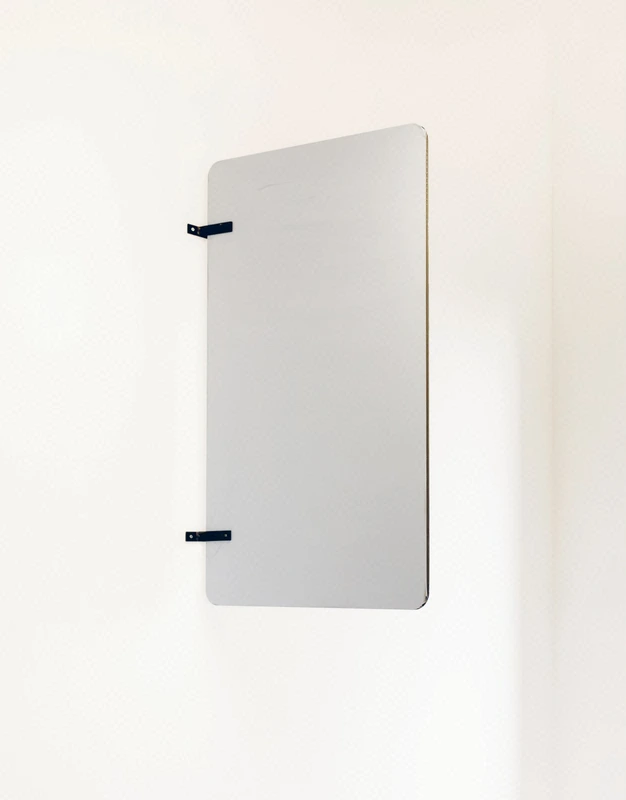
M: A group of your works was shown at Art Cologne that you describe as “mobile”, in contrast to your installation-based interventions. cookies and cream particularly caught my eye. While your typographic works such as surface focus especially on the frontal presentation of panel painting, here a pictorial surface projects into the room at right angles to the exhibition wall. Various references to the history of art and images seem to be invoked, from Piero della Francesca’s double portraits and the Russian sign painting that inspired the Russian avant-garde to the sign of a milk bar.
S: The work consists of two steel brackets that enclose an aluminium sandwich panel. The brackets are screwed to the wall and allow the panel to project vertically into the room, as you just mentioned. Both sides are painted quickly and gesturally with lacquer. It mattered to me that neither side should suggest a principal view. In my mind, the work is not really different from the typographic works that simulate standing behind the work. There is something like an initiating experience behind this whole question of the backs of pictures. I visited the Prado in Madrid when I was about sixteen, and recently remembered the room that had impressed me most. It was a fairly unassuming room where paintings on canvas were displayed in a large glass case. What was special was that the case stood in the middle of the room and you could also see the backs of the pictures. I still remember exactly how fascinated I was by the signatures and gestural scribbling on those backs. It was so present and real, not transfigured by skill and mastery or transformed into an image commanding reverence. That left a lasting impression on me. Much later I studied with Leni Hoffmann in Karlsruhe, who, through her own work, also introduced us more closely to Suprematism.
M: Grey plays a central role in cookies and cream, but also in your oeuvre as a whole. The exhibition title The amazing GREY seems like a hymn or homage to this (non-)colour. The painter and colour theorist Philipp Otto Runge called the grey at the centre of his colour sphere “indifferent grey”. What significance and function does this tone have in your work?
S: I like grey because it stands at the centre. I proceed from the assumption that grey is the sum of all colours and therefore combines the greatest possible painterly and chromatic potential. As an additive colour mixture, grey contains all colours; it is not mixed from black and white, but holds blue, yellow and red within it. Grey can also be differentiated into every possible shade and still remain grey. I do not demonstrate this process in practice but use a RAL colour that stands for this understanding. Runge, if I understand him correctly, identifies grey as a connecting element for transitions between chromatic colours and therefore characterises it as significant for painting. What bothers me is the subordinate role of grey that results from this. In my painting I do not want to assign this colour such a function.
M: You say that your work comes from thinking, and that once you have thought it through you become calmer. You describe the act of painting as something “magical”, and connect this to the question of what painting can be. The immediacy of the material also plays a part. Beyond the formation of artistic myths, these are interesting remarks about which I would like to hear more.
S: I will try to illustrate this with an example. When I am faced with the task of working in a space, I visit the place as soon as possible. Everything depends on this subjective experience of the room. Often, as soon as I have seen a space, I develop an idea. I also reflect on the works I have realised recently. Since I do not want to bore myself, I rarely show similar works immediately after one another, even if the exhibition venues are several hundred kilometres apart. If I have just realised a large typographic work, I then want to do something different or something new. The process of pictorial invention begins: I juggle all the parameters relevant to my work – space, painting, sculptural intervention. In my mind I work through movements and sightlines in the room; I think about colours and built elements, then about materials, surfaces and found objects. For open calls, such a concept is put into writing; for exhibitions, it is stored at the back of my mind as an initial concept. That is what I mean by “becoming calmer”. During realisation, processes and changes occur that I cannot foresee, but that also reveal my immediacy and spontaneity. My way of painting is immediate, cannot be corrected, and makes the artistic action visible. Everything I want or plan for a work culminates in the moment of painting, when it becomes clear whether a work functions or was merely an interesting thought.
M: Your work also has affinities with conceptual approaches. Is it important that you execute the works yourself?
S: A good question, and one I have often thought about. So far I have developed only one edition in which people were allowed to paint themselves. I still do everything myself and cannot yet imagine handing over the painting process I have just described. In principle, however, it ought to be possible to delegate it.
M: How do you respond to other readings of your work? With BEACH HOUSE, for example, I had different associations from those you described in our last conversation about it. To me, the reduced pavilion on the beach appeared to criticise the furnishing of the landscape and a modernist aesthetic that serves a neoliberal marketing of island tourism.
S: Just as I do not always have an influence on how my works are hung or the context in which they are shown, it is probably the same with how they are read. Of course I could have used BEACH HOUSE to point to the guidelines and parameters governing construction on the German coast. But for me this structure connects more closely to a basic wish for a place in nature.
M: Could you say a little more about the semantic level in your works? You mostly choose English titles. One often associates them with allusions to pop songs.
S: English conveys a certain universality. I always feel that German sounds too poetic and direct to me; I would probably have to develop other systems for titles to escape this trap. I want to be free, sometimes to be poetic and evoke images, and sometimes to state austerely and directly what a work is about.
M: During documenta 14, the question was raised again of whether painting that primarily addresses questions internal to painting and formalist concerns can also have and demonstrate political relevance. In view of current political darkening – the hegemonic isolationism of the United States, imbalances in globalisation and new fascisms in Europe – some voices argue that art must take a more explicit position and understand its role as an agent more decisively. How would you respond to such positions?
S: Through my works I try to sensitise people to spatial perception and new ways of seeing. I believe this approach still needs to be tested and developed. I find it absurd to deny significance to an art that refuses mere representation. It would be just as absurd to say that instrumental jazz, which seemingly conveys no message or tells no story, is superfluous. Of course I worry, but it would be wrong now to question my work in this way and abandon my aesthetic and conceptual path. What would be gained if every artist now stacked concrete pipes, built blood mills or draped buildings in sewn-together jute sacks? Art must function with a profound commitment to freedom and should be able to be anything – even in such difficult times.
M: You describe your painting process as an appropriation of the world and painting as a medium of formative exploration, an experience that children can already have when painting. You said it is an activity familiar to viewers, the memory of which you can trigger in the reception of your works. Today, alongside the cultural techniques of painting and drawing, children and teenagers are also exposed to entirely different apparatuses and digital worlds of images that may require other cultural practices. Do these play a role in your thinking about the image?
S: As far as art is concerned, I am an advocate of the original and the immediacy of the material. I also believe that we long for something “real”. This is not to deny that my works can be photogenic or inspired by cinema. Some of the frameworks for the text works and billboards are reconstructions of film stills. I try to explore the world through visual research. My works take their bearings from reality, counteracting or quoting it. I hope, at best and as already mentioned, to sensitise people to a new, conscious perception of place, space, architecture and everyday surroundings. Perhaps I can make a few Instagram accounts more interesting by prompting people suddenly to post painted-over graffiti, flaking lacquer or incorrectly painted road markings.
Roaming through the City
Annett Reckert
A: I would like to take a biographical approach to better understand where your interest in architecture comes from. Your hometown of Bottrop is an obvious starting point: industrial architecture, the Ruhr. As an art historian, I think of Bernd and Hilla Becher. How did you experience the Bottrop of the 1980s as a child?
S: I do think it shaped me. The district where I grew up had a fairly village-like structure, beside the municipal forest at the northern edge of the Ruhr. As children we spent a lot of time outside, roaming the area. The industrial architecture you mention was hidden behind high brick walls and only rose into view between the rows of houses. I remember that, as a child, I always wanted to know what was behind those walls and what the buildings looked like. It was not until the nineties that the gates opened and people gained an insight and the opportunity to explore these fascinating places legally.
A: Did your parents provide any artistic impulses?
S: My first impressions of building and shaping things probably came from my father. He completely renovated my grandmother’s house and converted every conceivable space. Not that we children were allowed to do very much … I still remember his respect for machines. And I like the olfactory stimuli of building: the smell of damp concrete, cut wood and worn angle-grinder discs.
A: You lived only a stone’s throw from the glass Museum Quadrat, the Josef Albers Museum. Do you have memories of it?
S: Of course. It was certainly impressive, although as a child I was mainly interested in the large mammoth skeleton in the natural-history section of the museum and a rusty Serra work in the museum garden. I no longer really know what fascinated me about it. But I also remember the building. It had a particular attraction, though I cannot name what it was. What impressed me then was the glass bridge connecting two parts of the building. I now think the building stood for something that reached beyond the town’s provincial structure. It was unfamiliar and urban; it was special.
A: And what about works by Josef Albers himself?
S: When I was about ten, I made a discovery in them that excited me. At first, though, they had not particularly interested me as a child. Perhaps there were simply too many prints hanging in offices or doctors’ surgeries. What those reproductions naturally lacked was the physical presence that the works gain from the brushwork and the direct effect of colour. In a truly surprising moment, I realised that this only happens when looking at an original. Only in the original do works reveal how they came into being, disclose themselves as made and painted.
A: During your studies you initially painted. Within the conventional rectangle? When did something click? When did you first take painting and installation into the room?
S: In this respect, green valley from 2011 was a key work. I had returned from a trip to Egypt with my academy class and was playing around in my studio. The work was definitely prompted by a few billboards I photographed in Cairo and on the way into the desert. I liked the idea of addressing a reverse side, banishing content and motif altogether and instead generating a pure, rough-edged painting. I also wanted to continue something that had already mattered to me in my representational works: showing and deciphering the painting process. green valley plays with the expectations and demands we place on images. I tried to undermine these expectations and point, with a wink, to what is visible. I think much of what I saw in Cairo gave me the ease to experiment, build and venture new pictorial inventions.
A: Do you find inspiration on your travels in Germany, Europe, Africa and Asia?
S: It is often the broken and imperfect that attracts me: when a wall has half collapsed and is provisionally supported, when a step has been painted by hand, when a section of a building has been shaped with particular care. I look for flatness; I like it when graffiti is painted over in a colour different from that of the wall, even though you are not really supposed to notice it. I love discovering lettering from the fifties on long-closed shops in the countryside, their windows inadequately covered with paper. Abroad, I like the fact that it often does not matter what something looks like. Cables and illuminated signs remain hanging even though they have long ceased to function. Or painted advertising signs, vacant premises and half-ruined things that arouse my curiosity.
A: Where do you find it utterly boring? Are there such places?
S: New housing estates. Deadly boring. Places of horror for me.
A: City creature or country dweller? Are you both, or is it always about the urban?
S: I live in the countryside, but without a connection to the city I would go under. I love roaming through the city. You are right: it is the urban without which I would lose the basis of my work. That is why I am grateful to have enough opportunities to travel to cities and work there.
A: Where does your gaze wander when you are out and about? More nose up – concerned with the bigger picture, façades, proportions and materials – or are you more of a sniffer, a truffle hunter, searching for details, displacements, gaps and curiosities, for anonymous architectures and charming improvisations in which DIY-store solutions and everyday do-it-yourself creativity come together?
S: Both, I hope. It is exciting to visit other regions and explore their characteristic ways of building. Sometimes it is the flatness and proportions that fascinate me. I like it when patina is visible, when something is not too hermetic. It is the austere and rough-edged that attracts me, rather than the completely staged.
A: You have already spoken about your passion for architecture’s backstage areas and your desire to look behind things. Could you return to that?
S: I think I attach great importance to the construction of a structure and its fundamental structural conditions. Just as with a panel painting, where the stretcher is important and necessary, as is the painting support, the cloth, without which painting of any kind would be impossible. I deconstruct and restage such components to create new relationships and ways of looking. I have just realised a work with galvanised metal sheets at Museum Folkwang that visualises, as it were, the ventilation ducts in the museum’s basement and walls. During installation we walked through long corridors beneath the museum and saw the ventilation shafts to which my work refers. It is not important to make a direct comparison; what matters is that the connection exists. Something else occurs to me. Around 2005, I went on nocturnal excursions a few times, mostly with André Sassenroth, to make photographic sketches for paintings on canvas. We roamed the Überseestadt district, which had not yet been gentrified. Sometimes we took breaks on the roofs of empty warehouses and stood behind billboards normally seen from a different perspective, from the front. This too was a situation of being backstage, for me one of the places of urban longing.
A: Your interest in lettering and typography in urban space places you in good company in art history. I will resist going into great detail …
S: I love Lawrence. I love Christopher and I like Ed. I simply enjoy lettering because it is not only a carrier of meaning but also a witness to its time and a record of fashions. At the same time, letters are a universal code through which one can communicate directly with viewers’ experiential knowledge. We are all confronted with messages, labels and information. I want to counteract this aesthetic of advertising and shortcuts.
A: Do you keep a diary of drawings and photographs, a pool of ideas, or am I thinking too systematically?
S: I take photographs to remember the structural gaps, peculiarities and architectural improvisations I have just described. I occasionally browse through this archive. Sometimes I find photographs several years old that prompt a work. But I do not really use it systematically.
A: Your heroes among the great architects?
S: Oscar Niemeyer for his sensuality, Mies van der Rohe for his logical structures, and Peter Zumthor for his fetishism of materials.
A: A building that represents the ultimate for you?
S: Without ever having been there: Casa das Canoas by Oscar Niemeyer, built in Rio de Janeiro in 1953. Clear forms, curved walls, views through, transparency. A house made for people. Inside and outside merge organically. I know the Niemeyer house only from images and reading, but I consider it perfect. I also think that an architect’s true mastery can be seen in relatively small buildings that correspond with their surroundings.
A: An architecture that is a no-go for you?
S: Just one example: the Beluga building on the Teerhof in Bremen, a bulky, multi-storey office building for the shipping company Beluga, which has since gone bankrupt. A more permeable architecture was needed there to lessen the separation of the two districts by the Weser. From Bremen’s Neustadt, however, the building feels as though one is facing its back. I consider it an urban-planning disaster, even though it received an award from the Association of German Architects. They speak of an inviting gesture and skilful articulation. My perception is entirely different.
A: Do you have a sense of what might be called wit in architecture? It is not exactly a richly cultivated field.
S: I cannot really judge that. It is probably because architects have to think so much about DIN standards and regulations that wit perhaps falls by the wayside. Yes, even when I think for longer about the architectural in art, not many artists come to mind. Gordon Matta-Clark and Michael Asher are rather rigorous in their concerns.
A: But some of your works do show humour?
S: Yes, perhaps. For example I stay while you go, which I like to describe as a backpack work; it is really no more than a small piece of luggage quickly strapped to a column. As if provisionally, the painted surface is mounted slightly askew on this column, whose position is absolutely static, yet which has been equipped – or precisely for that reason – with a fragile, subtle and mobile work. And in its title, I stay while you go also speaks directly to the viewer. I have to smile when I think about the work.
A: Beach House on Spiekeroog is an architecture that can actually be used. An excursion in both the literal and figurative sense. Could you imagine working more in an applied way, moving further into the field of usable architecture?
S: Of course I can imagine that. A year ago I designed another pavilion for a square in Nuremberg. Unfortunately it was not realised. I could certainly imagine developing ideas for rooms or public squares and giving them structure.
A: You think very carefully about the position and movement of viewers and users. Could that be described as one of your fundamental concerns?
S: Absolutely. I think a great deal about human scale. It is important to approach my works through movement in space and to grasp them from different perspectives. The relationship between the viewer, architecture and my work is decisive for the whole configuration. The work is only brought to life through engagement and looking. If it is not perceived, it is irrelevant. This does not mean it cannot be hidden. I like the idea that a work also has to be found.
A: To what extent are you a critic and utopian who opens people’s eyes and makes proposals for another way of building, for a clearer, more open, variable and playful architecture? For departure and reversal?
S: I would not define myself that way, because what I primarily want to achieve through my work is a changed, more precise and more complex perception on the part of viewers. I think it was in an interview with Erwin Wurm that I read that each semantic level of an artwork is like a finger on a hand. Each finger stands for an aspect of the work, and viewers choose the aspects with which they want and are able to engage associatively and reflectively. It is definitely important to my practice to think about the space in which my work takes place. If, after engaging with a work or an exhibition, someone says they now constantly notice niches and projections in rooms, for example, I am pleased, because there is no more I can achieve than contributing to a more alert, intensive perception and enabling a new, expanded, perhaps more open view of spaces, places or things. But to address another aspect of your question: I like rooms that function well. I have a good friend who lives in a large, listed Bauhaus housing estate in Berlin. The flat is not big but almost perfect. Everything has a comprehensible place; I love that. This is the exception, though: there is almost always something to criticise and improve.
A: Which spaces are ideal for you and your work? What spatial situations would drive you away?
S: I cannot say exactly. Repurposed spaces such as yours at the Städtische Galerie Delmenhorst, Haus Coburg, are just as exciting as a newly built museum. I have to say, however, that spaces with a history and traces of different uses offer more formal starting points for direct, site-specific interventions. In pristine spaces, on the other hand, my works have a less immediate relationship to the room and develop more from references to the backstage area of architecture you mentioned earlier. You cannot really drive me away with anything except low ceilings: they put me in a bad mood, but in the end I find a solution for those too.