The Gesture in Space that Preceded the Stroke
Senthuran Varatharajah
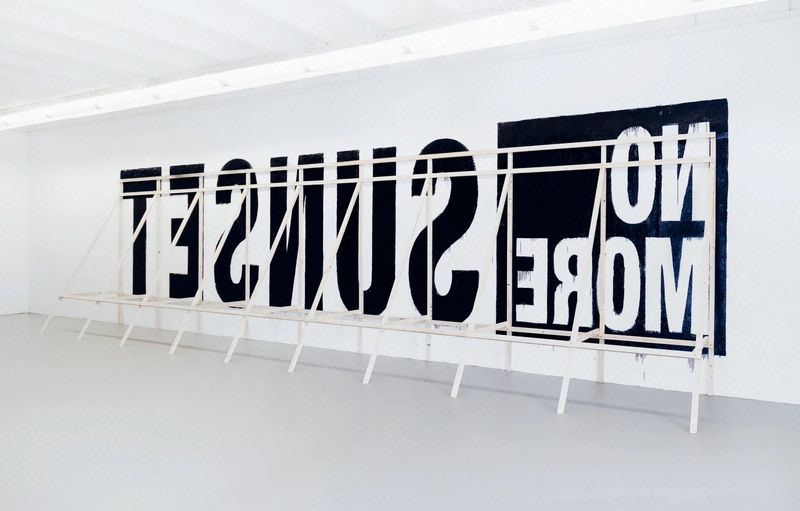
We look at the back of a sculpture: black paint. A white wall. Light wood. And screws. They have been attached to the wall like temporary scaffolding, as if they’re holding up the wall. It reads, like the back of an advertising banner, in capital letters and in mirror writing; black on white and white on black: NO MORE SUNSET. Sebastian Dannenberg‘s artistic process can be explained, almost exemplarily, in this work of the same name from 2013. Dannenberg reduces painting to its most elementary components: to form and colour; to dimension and material. To the gesture in space that preceded the brush stroke. Dannenberg reduces the substance in two ways: as a regression and as a restriction. Regression here means: the object acknowledges the physical movement that first establishes this object as the lasting result of a physical decision in space. Dannenberg thus rejects the mythical narrative of aesthetic production; his sculptures reveal themselves for what they are: as work, made from raw material, placed and constructed. This anamnestic reduction, which disenchants the image, must be understood romantically: a painted trace is also always the memory of a manual action, sometimes intentional, sometimes intuitive. The knowledge of a period of time in which a brush has touched a surface. This work of art is not just a transparent witness to the hand that has executed it: the work of art is its memory. Restriction means here: Dannenberg uses only ordinary, everyday material, in limited quantities, and limited, precisely applied means of expression. This compositional reduction, which emancipates the sculpture, must be understood politically: as a liberation of the image from its traditional pictorial function; as a revolution of form that seeks a different expres- sion; as a liberation of painting from painting itself. Dannenberg‘s methodical exploration of public spaces through gestures, his technique of a double reduction of substance, which comes from his trust in the material, but also in the artistic process, shakes the certainty of our eyes. Materials are recognizable and, as a rule, are not transformed in their appearance, so that they are perceived differently. In this way, his pictures and sculptures set our imagination in motion; each element emancipates itself from its conventional role as servant: as an equal element among equal elements, that no longer know any relationships of dominance and suspend any hierarchy of symbols. So we are looking at the back of a sculpture: black paint. A white wall. Light wood. And screws. Dannenberg‘s dialectical method of reduction and emancipation allows us to recognize more than just what this arrangement of material shows us: this sculpture expands the space, almost casually transforming itself in the process. As if we were waiting on the roof of a skyscraper and not in a museum. As if we were looking at the back of a poster that, black on white and white on black, negates the sunset so that we can look at it from this position, as if for the first time. As if every element, reversed and mirror-inverted, had finally come into its own, and only into its own. Art means both: seeing different things, and seeing things differently. Sebastian Dannenberg‘s works teach and remind us of this oldest magic of painting: everything could always be different. Every object is already somewhere else. And every object has already become something else here. We look at the front of a sculpture that shows us its back. And we see the sunset and its melancholy; a summer that, in the sunset, comes only to itself.