The Grey Noise
An attempt to define Sebastian Dannenberg’s spatial strategies in The Amazing Grey
Sebastian Schneider
It is an interest in what seems marginal, in what has been left behind and repurposed, that excites Sebastian Dannenberg’s thinking and stimulates his working process. We often spoke about his experiences travelling abroad, where he gathered a wealth of visual impressions that later influenced his work.
He described his discoveries in Ghana as particularly striking. There he observed how objects such as cars, houses and walls had been individually transformed by their owners in ways highly unusual in Europe. These were mostly graphic patterns, geometric shapes or symbols painted or sprayed onto the surfaces of the objects concerned. Sebastian Dannenberg quickly realised that these incidental discoveries fascinated him because he recognised something artistic in them. A hut painted with two luminous colour fields became a colour-field painting for him, or a brightly painted gate a linear sculpture in public space. He was especially impressed by the directness and imperfection with which these objects had been shaped. The painterly interventions appeared as strong assertions which, combined with the signs of wear and the marginality inscribed in many of these objects, produced something powerful and authentic that drew him strongly towards them.
Our conversations about these experiences helped me take such perceptions seriously and pursue them. They also gave me insights into Sebastian Dannenberg’s artistic thinking that continue to inform my engagement with his work. This subjective recollection at the beginning of an examination of his practice may therefore also help bring my reading of the work into a broader reception of his art.
For the exhibition The Amazing Grey at the Kunstverein in Mönchengladbach, the artist engaged intensively with public and semi-public spaces that are no longer used, examining how they change in this obsolete state.
Particularly in North Rhine-Westphalia, where the economy has undergone massive restructuring over the past forty years, everyone knows the effects of such processes. At best, a certain romanticism of ruins remains in the wastelands of former industrial sites. But what about places that do not carry the charm of the past, but instead expose the ugly side of the present: functional architectures conceived on a drawing board and erected according to a standard formula at any location? Fast-food restaurants or shopping centres, for example, whose endlessly repeated designs are intended solely to stimulate customers’ desire to buy.
In the 1990s, the French anthropologist Marc Augé introduced the concept of the non-place, which can be useful in this context. For Augé, non-places are monofunctional structures such as airports, shopping malls or railway stations. They are spaces of transit in which identity does not manifest itself. They are communicatively neglected places, places where the absence of humanity and history becomes palpable.
But what happens at and to these places when they are relieved of their function? Sebastian Dannenberg went there to pursue these questions and observed how functional objects become bare objects when their function is suspended. A gap emerges that can be considered aesthetically because it speaks volumes about the place’s history of decline.
Sebastian Dannenberg recognises the poetry of these situations; they stimulate him to set his working process in motion. He creates objects inspired by these discoveries without ever reproducing them one to one. Instead, he creates fragments of a reality that call up a familiar formal language of public space. Walking through the exhibition, we feel transported into these situations: the works recall rows of shops or advertising boards whose striking fragments of words evoke messages in public space. Other works, such as Aircondition. (Studio Version), refer through their titles directly to a world of things found in non-places, to use Augé’s term, such as car parks and shopping centres.
This obvious relationship to reality also changes the perception of the gallery: it becomes a passage to be traversed as if strolling through the city. The viewer becomes a flâneur. Such a response is by no means negative for Sebastian Dannenberg. He is keen to use architectural fragments to create a simulation of reality that is experienced as such. Through strolling and walking, the contemplative experience of the individual work becomes dynamic, and the viewer’s gaze is also directed towards its surroundings, the site-specific situation as a whole.
If we assume that Sebastian Dannenberg’s works create a space of their own, we must consequently also ask in what time that space can be located. I argue that the works the artist presents in The Amazing Grey invoke our immediate present. With elements such as fluorescent tubes or advertising letters, he addresses an aesthetic of commodities thoroughly familiar from today’s world of consumption.
The same happens in Aircondition. (Studio Version). As the title reveals, its form is inspired by an air-conditioning unit, recreated with the simplest of means: the shelves of a heavy-duty shelving unit in the artist’s studio. Yet other objects from the cosmos of our present may also come to mind. Plastic stacking boxes supplied by self-storage companies are a particular example.
In the radically accelerating world of work and life in the 1960s, huge warehouses were built in the United States in which city dwellers could store their possessions, because increasingly scarce urban housing no longer offered enough room to settle permanently.
An imperative of mobility deeply inscribed in such a concept has since spread globally, leaving hardly any area of life untouched. Professions have become fixed-term jobs, production is outsourced according to demand, and low-cost flights or video calls allow us to be everywhere all the time. Under these conditions, the stacking box, stored in places that presumably correspond strikingly to the non-places described by Marc Augé, acquires a new, indeed metaphorical charge. In its minimalist, pristine appearance, Aircondition. (Studio Version) seems to address such a loss of identity directly.
Alongside this chain of thematic associations, however, another element inherent in Sebastian Dannenberg’s works demands attention: his use and handling of colour.
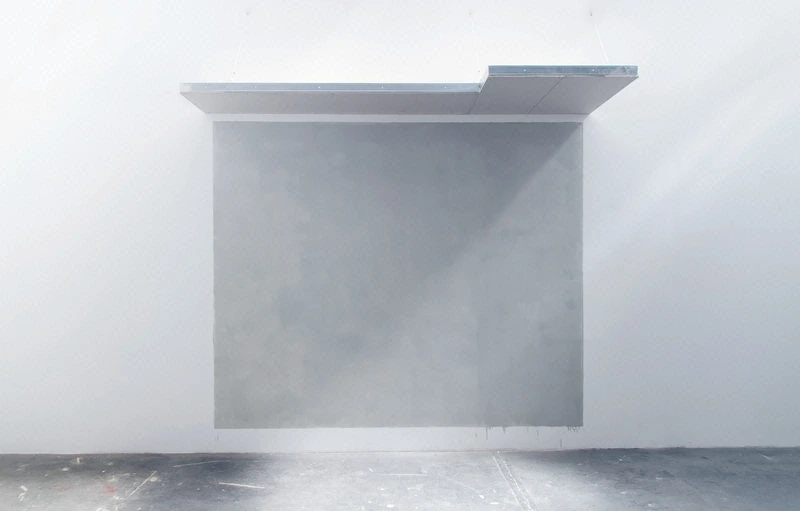
We see canopies accommodating grey monochromes, fluorescent tubes framed by a blue rectangle, and letters filled with deep black. As in many of his other works, Sebastian Dannenberg executes these paintings directly on the wall.
The way he uses colour seems to add a pleasurable moment to the works, contrasting with the rigour of their sculptural constructions. The surfaces and lines are so richly filled that paint drips beyond their boundaries. Visible brushstrokes invoke a painterly gesture.
This pleasurable handling of colour is not merely a way of acknowledging his own entanglements with painting. Rather, through colour Sebastian Dannenberg negotiates the conceptual questions he puts to the medium: specifically, painting’s potential to generate spatiality. This is complicated by the fact that, at least in traditional panel painting, such an exploration always takes place on a two-dimensional surface and must therefore remain illusory. Sebastian Dannenberg has left this conventional form of painting behind and transferred it into three-dimensional space. Painting loses its representational function and instead acts as a marking or assertion, intervening in the sculptural staging as an equal element.
When one of the shelves in Aircondition. (Studio Version) folds forward, revealing a red surface behind it, the object’s visible face is extended by a space beyond. We cannot see whether similar colour fields are hidden behind the other shelves, but automatically consider their potential existence. The wall object thus expands into an imaginary sphere. In the viewer’s mind it becomes a three-dimensional object with a front, back, top and bottom.
This is not, of course, about devising a puzzle whose solution would be revealed by lifting a lid. The play of visibility and invisibility seeks to destabilise conventional categories that reduce the sphere of a work to its factual body. Works such as Aircondition. (Studio Version) thus succeed in extending their manifest status as objects into an imaginary sphere. Sebastian Dannenberg investigates the idea that space need not necessarily be physically tangible.
His work thereby connects with theories of space that have been intensively explored in scholarship, especially by poststructuralist thinkers. These theories expand the understanding of spaces as purely physical places by recognising that conventions, rules or politics can also generate invisible spaces, which we perceive as such and which then enter our thinking and behaviour. At the level of the works themselves, The Amazing Grey points to this theme and resumes its conceptual ambition to assert an artistic engagement with the non-places of our present. The exhibition’s works thus challenge us to determine our own relationship to these places.