who is next?
Ingo Clauß
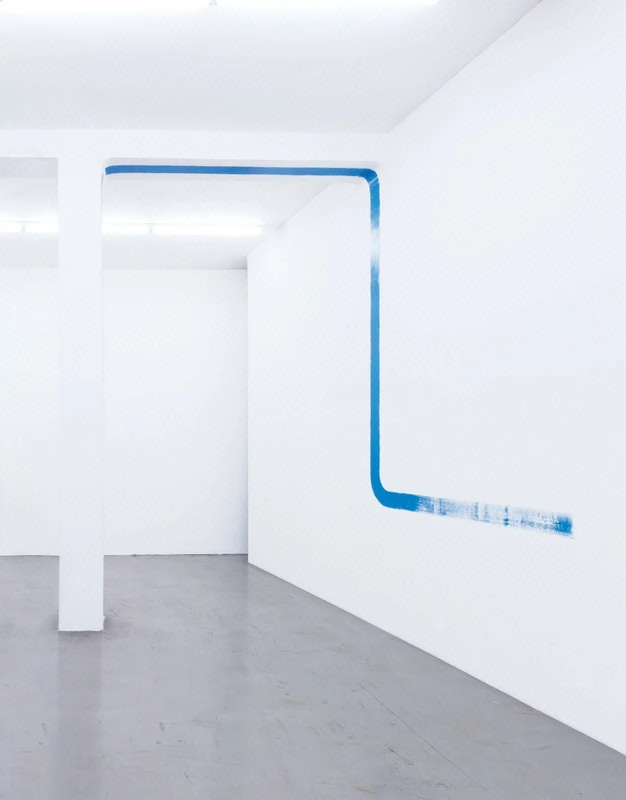
In his artistic practice, Sebastian Dannenberg explores the open possibilities of contemporary painting. He rarely uses classic picture supports on stretcher frames, instead working directly on the exhibition wall, but also likes to incorporate the ceiling, the floor and other room-structuring elements. He uses commercially available paint, which he applies in a single color - as a surface or stripes, but sometimes he also creates oversized words in mirror writing, the aesthetics of which are borrowed from American billboard advertising boards.
The expansion of painting has been tried out in many ways since the 1960s. Indeed, Dannenberg's works bear witness to an engagement with positions of Minimal and Conceptual Art. However, there are also clear references to constructive-abstract painting and the concepts of Suprematism. Against this background, Dannenberg has developed a completely independent and contemporary position. His site-specific works are generally not intended to be permanent, but disappear under the whitewashed walls after the exhibition. They are temporary markers that nevertheless develop a special presence and intensity. Dannenberg is inspired by the architectural features, emphasizes them and sometimes adds further architectural elements, a projection, a curve or a multi-part slatted frame. Diverse and thought-provoking references are created between the location, the viewer and the artistic setting.
For the exhibition at the Weserburg, Dannenberg has drawn a blue strip of paint. It begins at a supporting column, rises vertically, curves across the ceiling like an arch and descends vertically along the opposite wall before finally turning to the right and running out horizontally. Dannenberg has rounded off the two transitions from wall to ceiling with seemingly makeshift additions, allowing the strip of colour to nestle closely against the architecture. Dannenberg’s painting does not subordinate itself. It accentuates, alters, expands and unsettles the space, yet ultimately remains entirely painting.