Konkret Bremen
Ingmar Lähnemann
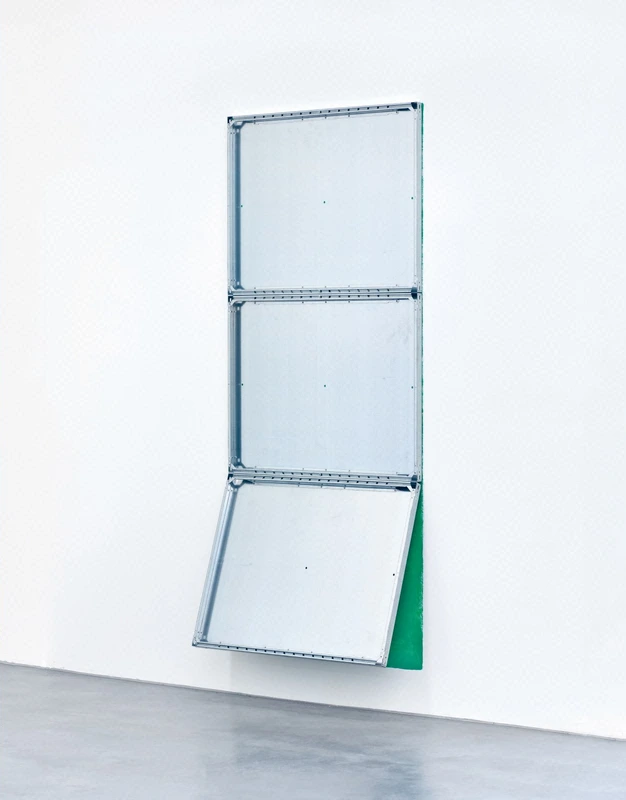
In his work, Sebastian Dannenberg frequently refers to spatial situations, using materials that seem familiar from contexts outside art. Elements that he brings together in sculptural installations remain legible as individual components and appear to refer to other spaces or architectural situations. For the work exhibited in ‘konkret bremen’, which belongs to one such group of works, Dannenberg uses three galvanised metal sheets, bought as standard, industrially manufactured products, as in a classic work of Minimal Art. He employs them as material components with their own distinct colour and mounts them one above the other to form an elongated vertical format. This highlights the tactile, aesthetic and material qualities of the sheets, while their everyday function remains visible and creates an ambiguity for viewers. As with many of Sebastian Dannenberg’s works, the question remains whether parts of the installation might actually belong to the space itself.
Yet a conspicuous and intensely coloured painterly addition makes it abundantly clear that this is an artistic intervention. Folding the lowest sheet upwards appears almost accidentally to reveal what lies behind it, exposing a monochrome orange surface. The ragged edges define a swiftly executed painting. Here, the colour seems almost to burst forth. The visible brushstrokes undo the constraint imposed by the metal sheets above it; the two different parts of this painting-sculpture enter into a relationship of tension that nevertheless remains balanced in the viewer’s perception. One consequently feels confronted, in equal measure, with a reflection on monochromy, painting and materiality.
Standing before the work is meant literally here, for it immediately evokes a physical relationship with viewers, to whom it reveals painting’s seemingly hidden secret. Crucially, it relates so clearly to its location that one feels one is looking at a permanent part of the exhibition wall. Dannenberg achieves this both through his situated use of painting on the wall and through associations with functional aspects of this artistic intervention. To this end, he makes minimal, associative interventions in materials whose potential for aesthetic transformation is already inherent when one encounters them in a hardware store, but which one usually only recognises through their artistic transformation.