Painterly Action in Space
Medium Specificity in the Painting of Sebastian Dannenberg
Julia Katharina Thiemann
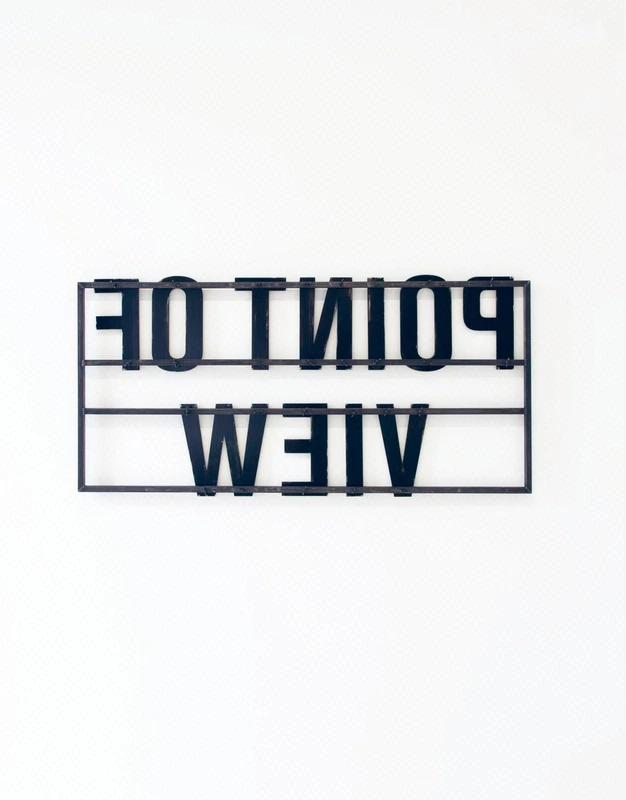
“POINT OF VIEW” — large black letters appear in mirror writing on the exhibition wall, opening up a discussion of perspective. The letters of this typographic work are held by a metal structure, much like an advertising sign. Here Sebastian Dannenberg plays with structures of perception and everyday fields of association, which he incorporates into his painting.
In point of view, the work that gives his exhibition its title, Dannenberg uses mirror writing flanked by a supporting structure to address perspective, which has played a significant role in painting for millennia. Perspectival thinking runs throughout Dannenberg’s oeuvre, revealing a fundamental constituent of his practice. His works consistently move between abstraction and literal narration, minimal monochromy and brushwork, construction and imagination. This gives rise to a distinctive tension in space that always incorporates the viewer’s position and movement.
This tension is also exemplified by Dannenberg’s catch a little blue (2017), a monochrome blue field painted directly onto the wall. A simple, handmade wooden frame with steel corners is secured to the wall over its outer edges by two orange tension straps. Yet this framing structure neither holds nor supports the painting; instead, it rests precariously under tension on the painted surface.
In this series, the play with apparent rear views is evident: at first glance, the actual display side seems hidden against the wall, revealing what appears to be the reverse, which in turn exposes the supporting structure. The cognitive effort of reading mirror writing accompanies an opening or displacement of space, a radiation from inside to outside, and an engagement with the wall as a means of presentation, material presence and boundary. These are not the only works that reveal how important acting as a painter is to Sebastian Dannenberg. His painting incorporates sculptural elements without ever entirely leaving the realm of painting.
Displacements, perspectival thinking and the interplay between the front and back of a painting, between the visible and invisible, the explicitly shown and the associated, also connect Dannenberg’s works to the thought of the philosopher Maurice Merleau-Ponty (1908–1961). He believed that things take on a new appearance in the painter’s gaze and that the resulting paintings undermine the conventional division between inside and outside. For Merleau-Ponty, painting is thus “the inside of the outside and the outside of the inside”.
In Sebastian Dannenberg’s work, such ideas about reconstituting our perception of the world through painting always go hand in hand with a straightforward use of painterly strategies, such as planar flatness. These reflect his close relationship to classical painting and to the panel-like surface of a stretched canvas, establishing a concentrated, direct connection across his different works and approaches. This protects them from arbitrariness and aimless dissolution of boundaries, forming a distinctive frame of reference. At the same time, his mostly site-specific paintings undermine a fundamental condition of canvas painting, which is normally characterised by mobility. For a long time now, Sebastian Dannenberg has no longer painted on canvas, as remains customary in classical painting, but understands the exhibition space itself — and especially the walls of the white cube — as his painting surface. He often fits his works precisely into the spatial structure, sometimes developing his artistic interventions only in relation to the given spatial parameters.
In the construction of GREY (2017), which, like point of view (2017), is connected to a scaffold or frame and thus given a boundary extending into space, Dannenberg also questions the functions of content, form, support and protection in the relationships between image and frame, front and rear, pictorial space and exhibition space. Grey, as the sum of all colours and thus an attempt at synthesis, is symptomatic of Dannenberg’s approach to conceiving his works. His paintings display a reduced palette with a high proportion of grey tones, selectively supplemented by other colours, particularly blue, and by coloured objects such as orange tension straps. Greyfender (2017) combines the grey of painted car tyres mounted directly on the wall with the humorous idea of the possibility of infinite painting.
Yet it is not only colour but also surface that repeatedly plays a decisive role for Sebastian Dannenberg. His surface now (black) (2017), a grey field painted on steel and bordered by a painted black stripe along the sides and lower edge, likewise plays humorously with paint application and brushwork, as well as the framing or delimitation of the pictorial surface in relation to the surrounding space.
In the typographic text works, the image also functions as a speech act and is thereby associated with a linguistic proposition. Just as exhibition wall and pictorial surface are inseparable here, so too are index and object, forming an indissoluble unity with the site of presentation. For Dannenberg, movements that dissolve boundaries and extend painterly gestures into space always accompany movements of delimitation, construction, apparent support or definition. The freely coloured brushstroke that appears here and there always correlates with precisely defined, abstract, monochrome flatness, and often with smooth metallic surfaces.
Dannenberg constructs his works from parameters that have constituted painting itself for millennia. These are now addressed self-reflexively in his works and skilfully related to a given spatial situation. By focusing his artistic interests, in both content and form, on examining painting’s constituents, he unites works that are quite heterogeneous in appearance, materials and approach through fundamental questions about the nature of painting.
While the American art critic Clement Greenberg, for example, still emphasised an essential definition of the medium of painting in the mid-twentieth century, based on conventions and norms such as a flat surface and the properties of pigment, art historians such as David Joselit and Isabelle Graw now argue for a concept of painting that is not medium-specific. Without losing sight of the residual specificity that often remains, they thus break with modernist ideas. “As a first step, one would have to […] work with an expanded concept of painting, which implies a break with the modernist understanding of painting. For modernism, painting was a clearly delimitable art form determined by the essence of its medium.”
Sebastian Dannenberg’s practice should therefore clearly be understood in the context of an expanded concept of painting, exemplified by David Joselit’s now frequently quoted phrase: “Painting is beside itself.” Despite its partial expansion, Dannenberg’s painting remains rooted in the genuinely painterly. It follows the movement of modernity from self-reference towards self-reflexivity, which Isabelle Graw, among others, identifies as a fundamental characteristic of contemporary painting. At the same time, Sebastian Dannenberg’s works always operate within a field of medium specificity that unites and distinguishes his approaches. This double movement defines his aesthetic and constitutes the potency of his works.
It is no coincidence that the appearance and strategies of many of Sebastian Dannenberg’s works refer to movements that distanced themselves from modernism, such as Conceptual Art from the 1960s onwards. These marked a clear break with questions of medium specificity that had remained decisive for Greenberg. Dannenberg sometimes addresses these aesthetic questions within the works themselves. Artists such as Blinky Palermo (1943–1977) have been particularly influential. In his ongoing series for blinky, for example, a blue triangle installed above entrances outdoors, he engages directly with Palermo’s Blue Triangle (1969). In the late 1960s, Palermo created an edition of prints featuring a blue triangle, accompanied by a stencil and instructions to use it to paint a blue triangle of a specified colour above one’s front door and then give away the original print. While Palermo’s work, which opened up the concept of art, referred to Kazimir Malevich’s Black Rectangle and Blue Triangle (1915), a significant work for the development of abstraction, Sebastian Dannenberg now refers directly to Palermo’s practice by installing blue triangles as lightboxes above entrances in public space, in a kind of restaging.
The French artist Daniel Buren (b. 1938) has also had a far-reaching influence on contemporary painterly practices that work through a relationship to space, particularly regarding painting’s expansion into architecture. His distinctive stripes occupy entire rooms, giving them a painterly rhythm. Sebastian Dannenberg pursues similar strategies of expansion and, at times, hybridisation of his paintings into space. In doing so, he operates on the one hand within the “post-medium condition” (Rosalind Krauss) — a strand of post-medium art, and thus of medium non-specificity, in which works are no longer defined by their medium. On the other hand, he explicitly addresses mediality itself in his works, developing them fundamentally out of the conditions, conventions and traditions of painting.
This double movement of detachment and simultaneous attachment is strikingly evident, for example, in Bar Julia (2017). The work refers to the presentation of double-sided panel paintings in two-sided frames that project into the room rather than hanging flat against the wall.
While the means of presenting double-sided images are directly transferred and thus evoke clear associations, Dannenberg replaces the painter’s canvas with an aluminium sandwich panel. Its sign-like character also introduces aspects of everyday encounters with advertising strategies. At the same time, following our habitual way of looking, we first attend to the lateral surfaces of the picture, which normally receive no attention in paintings. We thus view painting as a format and in its constitution in a new way.
His subtle and humorous artistic interventions can therefore sometimes seem like little traps or concealed back doors, testing the viewer’s close perception, prior knowledge and ability to abstract and associate. He himself titled a large-scale spatial installation Trap (2017): a large painted wooden triangle is placed on the floor and largely raised by a rope construction redirected twice across the exhibition ceiling, with a concrete counterweight inside a former can of balsam turpentine. The fragile balance of this surprisingly light-seeming work is thus sustained by a concrete-filled can of painting material, a substance that binds pigments and allows them to appear durably. Here again, this painterly and sculptural work combines primary colours with grey as a synthesis of all colour values. Sculptural gestures are combined with a painterly treatment of the coloured plane in space. This plane not only begins to move but seems almost to take off, forming a concealed spatial niche while being held in balance by the weight of the binding medium.
Especially in an era when the post-medium character of art is so often proclaimed, after more than a century of boundary dissolution and apparent disintegration, Dannenberg achieves a balancing act. He deliberately, intently and exclusively invokes one medium — painting — while testing its limits and possibilities with an open approach that can increasingly include sculptural gestures, without becoming sensationalist or merely working through a set of possibilities. Instead, his works convey a serious inner search for the potential of painting, always taking the parameters of the exhibition space into account.
In the works brought together here in the exhibition point of view, Sebastian Dannenberg deliberately explores the specificity of painterly codes. At times he himself pursues a removal of specificity, yet always leaves a framework, a “residual specificity” in Isabelle Graw’s sense, which is often the very source from which the work emerges. His works attempt to redefine the nature of painting within his own practice, and in doing so to redefine painting itself, without abandoning the painterly in his aesthetic. This reflection on the discipline through painting’s own means and strengths, together with a reflection on its means of presentation, particularly distinguishes Sebastian Dannenberg’s works and generates their potency in spatial experience.