Limitless Minimalism — Space, Material and Relating with the World
Bukola Oyebode
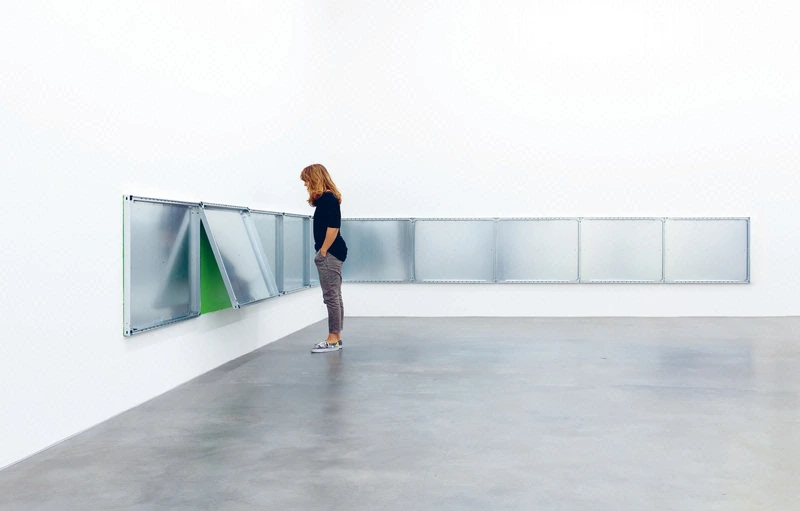
Minimalism and abstraction, in general, lead us toward restrained, measured and precise objects, gestures, or spaces. The inclination toward doing in the most concise manner and without excess material trace. These attributes, at the core of the minimalist art movement, were strongly pursued, in addition to working with systematic forms and modular structures. Corresponding movements, such as Post-Minimalism and Conceptual Art, which sought more expressive forms and materials, emphasized the circumstance of encountering an artwork and the viewer‘s response to an artistic gesture or intervention within a specific environment, (with Conceptual Art rejecting the artifactual quality of the art object). However, despite the emphasis on process and material exploration, these movements downplayed crafting and technique in favour of concept.
Sebastian Dannenberg‘s work, though characterized by the formal language of these movements, generally strays from, appropriates and critiques the restrained and concise gestures and expected modes of intervention. He embraces craft and technique in the same way he adopts theatricality around the form and has a keen interest in the space. How we see or receive his “performed” gestures also matters. The viewer is forced to consider how specific materials and gestures contrast, alter, accentuate or blend into the architectural structure or context of the space.
The material infrastructure and references in Dannenberg‘s art are primarily industrial and architectural, but he also engages other references. Everyday scenes and novel experiences, from Germany to Italy and from Ghana to Egypt, such as scaffolding structures, washed-out street posters, conveyor belts, highway contrast lines, text graphics, advertising billboard displays, 1960s window frames and vertical blinds, are appropriated, deconstructed or reconstructed into new shapes, colours and forms. Often, these transformations are recognizable such as in the exhibition Backspace. The red iPhone shape, the vertical structure reminiscent of window blinds and architectural facades and the nod to wall-mounted air conditioners. Sometimes the source inspiration remains abstract and unknown to the viewer, like the curved blue structure inspired by a moving van curved advertising panel the artist saw in Italy. Works by Donald Judd, Fred Sandback, Dan Flavin, Jo Baer and Robert Ryman are influences that contribute to his minimalist formal aesthetic.
A distinct characteristic of Dannenberg‘s work is how he transposes the playing around one expects in a studio environment into his site-oriented installations, primarily to influence perception. The little smears, the visible taping remains, the painting marks or markings in the space, and the backside of the finished form are not accidents but part of “performing” the process. These are typically accomplished in a way that does not replicate the studio but shows details of crafting the work which are usually hidden when exhibited. Unlike artists who prioritize only the concept and have their work done by others (for example, Donald Judd in his later years or Lawrence Weiner, who proclaimed the written idea as his art), Dannenberg crafts most of his installation objects and emphasizes placing subjective gesture on them. When not using fixed second-hand materials, he attempts DIY woodwork and metalcraft. One can see this through the imperfect features and recurring patterns that mark his work.
While this may seem like placing much focus on skill or technique, showing the work‘s process, even as a whimsical statement, can be beneficial to artists. We see that there is more to a specific piece, such as artistic labour and intentionality, than simply being an idea. This is an attribute that process-based artists highlight by showing more material imprint and the affinity between action and materiality. Likewise, the traces of the transformation of material or objects in the production of work have “material agency”, for the art and the artist. Thus, a site or work bearing traces of the artist‘s physical actions can be significant for the viewer or visitor to relive that process and re-engage the artist’s labouring body – within the site or elsewhere.
In a typical site-based intervention, Dannenberg adapts to space by adjusting his idea to the environment. This process begins by first seeing the space and inserting his bodily experience and relation to it into the work‘s conceptual development. This way, his body is directly and physically involved in the making process. But the body of the site visitor is also crucial. Standing in front of one of his pieces, you feel yourself in relation to what you are seeing: which can be the whole intervention or its details. For instance, the long contrast line shapes how one moves through the space, and the window frame adjusted to the average visitor‘s height changes how one sees signage. There are also the edges of painted forms that are not taped and lousily painted to indicate the action and process of painting. This is something the artist enjoys doing to demonstrate the connection between his work and painting; how he relates to a space like a canvas.
Though what one sees is generally sufficient in the aesthetic sense, there is more when one draws intersecting lines between the materials and the real world. Dannenberg engages the material world to emphasize that any art discourse on ecology, climate issues and sustainability which does not closely engage the materials of art and their impact on global environmental crises is incomplete. Rather than simply exploring materials, he has a conscious and traceable method of repurposing and recycling them which is exciting to follow. First, he repurposes secondhand materials (for example, vehicle tyres, metal fixtures and wood), then extends their lifespan by further reusing or upcycling them into different works through new forms and functions, for as long as they remain in his world. A recent example of this is using the planks from the commissioned billboard installed in front of the Kunsthalle Bremen in 2023 to make colourful furniture (benches and stools) for the museum visitors in 2024. He also draws attention to specific materials and objects that can harmfully impact the environment or humans. As Andreas Malm argues in The Progress of this Storm, the total removal of the human hand in profoundly shaping its environment only enables the capitalist logic of exploitation and breeds grounds for unaccountability. Therefore, addressing shifting climate conditions and environmental issues without examining artistic materials and processes is hypocritical. Artists cannot be exempted from being accountable for the materials they use even when recreating their environment. In this sense, Dannenberg‘s circular material approach is more holistic than simply working with nature.
Beyond aesthetic and material intervention, Dannenberg‘s work has a poetic appeal. The backside of text graphics, the painted walls with incomplete scaffold setup, the hyperreal iPhone frame and the architectural treatments come with humour and questions. There is always the sense that one is witnessing in-between situations: like is this a painting or an installation, is this a fragment or the complete work, is this an art piece or something usable, is this staged or real labour? There is also an interplay between the presence and absence of bodies, and between visible and abstract worlds and experiences. The hybrid forms, the circular approach to materials and mutable ideas are essential parts of how he relates to the urban space, which is always evolving and under construction. Although his interventions are unique and different, they are one continuous idea.