Painting All-Around!
Julia Galandi-Pascual
“Look, I‘m blind, look.” This is written in large, perfectly painted, coloured letters on a canvas and illustrates how the Swiss painter and conceptual artist Rémy Zaugg, who died in 2005, addressed questions of perception in quite a provocative way. From his painting practice, he formulated general assumptions for a processual understanding of his work, with which he took a new look at spatial, architectural and urban contexts. His aim was to explore language and perception as media for activating the viewer.
Sebastian Dannenberg‘s art also persistently seeks exchange in this sense: a counterpart in space, a perceiving subject, in order not to simply remain something material, but to achieve meaningfulness in the here and now.
Sebastian Dannenberg belongs to a younger generation of artists whose art reflects a contemporary-critical attitude towards the traditional idea of understanding the image as a hermetically sealed entity. Instead, in his artistic works he always examines the visual effect of the work itself in relation to the viewer. As diverse as his artistic language, which has been developing for over ten years now, may appear, Sebastian Dannenberg sees himself decidedly as a painter, as Rémy Zaugg did in his day. It is the perspective, as he himself emphasizes, from which he thinks about his work. It is therefore not surprising that colour and the use of it are a recurring central moment in the production of his work.
While at the beginning of his artistic development, the image as a result of his painting still seemed desirable, the focus changed over time. In fact, the world around him continues to be a reference, but long since without being directly legible as such in his works. Nevertheless, Sebastian Dannenberg still regularly uses his camera to document what he sees by chance. He cultivates his own pool of images with visually stimulating, fleeting impressions and momentary scenes, from which he uses contemporary image forms to translate visual practices from our everyday lives into works. It is therefore no coincidence that many of his works are formally reminiscent of shop windows, billboards or even displays in our spectator society, in which we are used to being able to see everything and everywhere at all times thanks to digital technology. In precisely this present, Sebastian Dannenberg‘s art deals with questions of visibility and its origins in a way that is both simple and fundamental: what is given to be seen and how, and what conditions result for perception.
At the same time, fleetingness is the bane of our perception, absorbed as it is by digital imagery, which is why precisely what is visually tangible and sensually perceptible at first glance in his works may not seem particularly worth seeing. Does it require a substantially increased level of attention when it is apparently just paint that appears to be quickly applied, sometimes directly on the wall, sometimes on or behind special carrier materials? Yes! At the very latest when the picture appears to be supported on the wall, for example, it is suddenly no longer so clear what we are actually looking at: the front or just the back of a painting which, either way, negates any representational function. The same applies to the ongoing series of works, in which individual words or pairs of terms become meaningless written images in reverse order: What orientation do such visualized terms as “American Standard”, “Point of view” or “Shift and return” then provide? While decontextualizations are deliberately used in the communication forums of social media to systematically distort attributions of meaning and values, Sebastian Dannenberg‘s painted statements aim to open up a view beyond political, sociological, social and cultural imprints and seek to broaden the view of the world and how it apparently functions in an independent way.
The ambiguity of simultaneous visibility and invisibility that is deliberately staged in Sebastian Dannenberg‘s works invites the viewer to activate the images himself. The painted surfaces may, indeed should, become backdrops for individual projection. A perception of this quality is possible precisely because the coloured surfaces are clearly visible as paintings in themselves. In this current environment, the present painterly gesture may at first glance appear just as lapidary as the traces on the user interface of smart devices. However, Sebastian Dannenberg‘s works are above all a blessing because they do not simply show how paint was applied. Instead, the recognizable form of manifestation creates a visuality that cannot be perceived purely rationally, but rather sensually and aesthetically. Because it only appears just so and just there, we can vis-à-vis pursue questions about the conditions of visibility in the picture: When do we perceive images as such? What conditions are needed to be able to attribute meaningfulness to the purely material? In this sense, Sebastian Dannenberg‘s painting is never an illusion, but always real in the truest sense of the word.
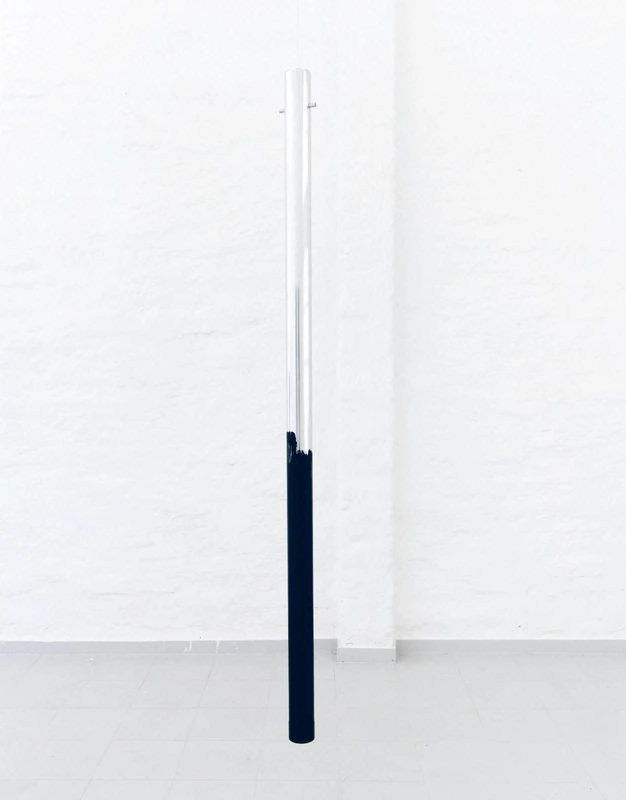
Starting from the brushstroke, which is the obvious manual action, the nature of the support and the format of the works are ultimately equally significant parameters of action. The use of paint on entire walls, in the white exhibition space as well as in public spaces, on manufactured materials such as foil, glass panes, steel and aluminium plates or, most recently, on three-dimensional elements such as plant pots or pipes, leads to ever-changing pictorial forms: “Only the action and the base determine the respective appearance.” While the materials he favours appear raw and are often reminiscent of construction sites or temporary structures, his treatment of them with paint turns them into independent forms, which as such question the nature of images. Even though Sebastian Dannenberg is aware of the performative dimension of painting and wants to enable participation in the discourse through its comprehensibility, he never celebrates the individual gesture. On the contrary: following a modular principle in which pictorial elements are constantly reassembled and dissolve after a while, he is concerned with the search for possibilities of visibility. This is why his paintings rarely appear in the conventional panel painting format, but can basically take place anywhere: In the room on the wall, over the corners, on the ceiling down to the floor, on the façade of a house or on the street. This variety of locations also makes it clear that the results are never individual assertions that only appear when viewed in isolation, but that Sebastian Dannenberg engages with the image anew each time, examining its possibilities, but also its limits. He therefore always puts the answers that are relevant to him up for discussion. This approach to his own work points to an attitude that, instead of holding on to ideas of uniqueness and exclusivity, is characterized by considerations of provisionality, the temporary and the mobile. An attitude that develops in the present with all its respective conditions and that is always able to include its audience. With his explorations, Sebastian Dannenberg‘s art is therefore aimed at active viewers who do not seek appearance in the experience of art, but reality – in the best case, their own. And in this sense, his painting is all-encompassing.