Hanging Out with Donald Judd
Sebastian Dannenberg’s own works enter into a spectacular dialogue with the collection of the PEAC Museum
Dietrich Roeschmann
When Sebastian Dannenberg was invited five years ago to take part in “Allerbeste Aussichten” at Freiburg’s Kunstraum Alexander Bürkle, a platform for young talent, he did not bring a quiet work that might have been read as restraint, or even humility towards art-historical heavyweights such as Donald Judd or Agnes Martin, whose works had had to make way for his appearance and retreat to the basement of Paul Ege’s collection. Quite the opposite. Dannenberg made a splash. A very big one. At hip height, he mounted the expansive work “APM Aircondition” on the wall: ten framed zinc sheets that could be tilted like ventilation grilles, revealing a toxic green behind them. Paul Ege, who died in 2019, liked this self-assured exploration of the relationship between image and space so much that he acquired the work for his collection. Since then, it has appeared repeatedly in exhibitions, each time making good on its remarkable tension between awkwardness and adaptability.
At Freiburg’s PEAC Museum, as the former Kunstraum Bürkle is now called, “APM Aircondition” now hangs in three modules, one above the other, against a blue ground in the final room. In a sense, it provides the closing statement of Sebastian Dannenberg’s spectacular solo exhibition, which is in fact much more, and something entirely different from a conventional solo show: more a kind of carte blanche. PEAC director Julia Galandi-Pascual, who will leave the museum in September after eighteen years to join a private collection in Marburg, invited the forty-two-year-old to bring his own works from recent years into dialogue with the museum’s outstanding collection, and vice versa. Dannenberg, who studied for several years at the Freiburg branch of the Karlsruhe Academy of Fine Arts before moving to the University of the Arts Bremen, where he was a master student of Stefan Baumkötter, knows the collection well. He has seen many exhibitions here. As an artist, he shares its keen interest in the question of what, precisely, an image is, a question explored here in ever-changing facets. He shares its interest in hybrid states between sculpture and painting, surface and space, as well as the fondness for a minimalist formal language that is so characteristic of the PEAC collection.
Dannenberg took two weeks to playfully confront his own, often site-specific works with selected pieces that had caught his eye in storage or had inevitably crept onto his list from the echo chamber of his own experience of looking. The result of this research is a refreshingly radical overhaul of these halls of reduction. Just how strongly Dannenberg relies on a strategy of deconstruction and reconstruction becomes apparent in the very first room. A huge rectangular colour field, applied directly to the wall in a shimmering orange, appears to be propped up by scaffolding resembling the supporting structure behind a billboard. On the opposite wall, Dan Flavin’s neon work “Untitled (for Otto Freundlich)” glows in response. In this setting, however, it does not play the diva it might have been, but is simply a partner in a conversation without hierarchies about the interweaving of everyday, urban and art-historical spaces and their sightlines. One might call it an activation of shared potential for the present.
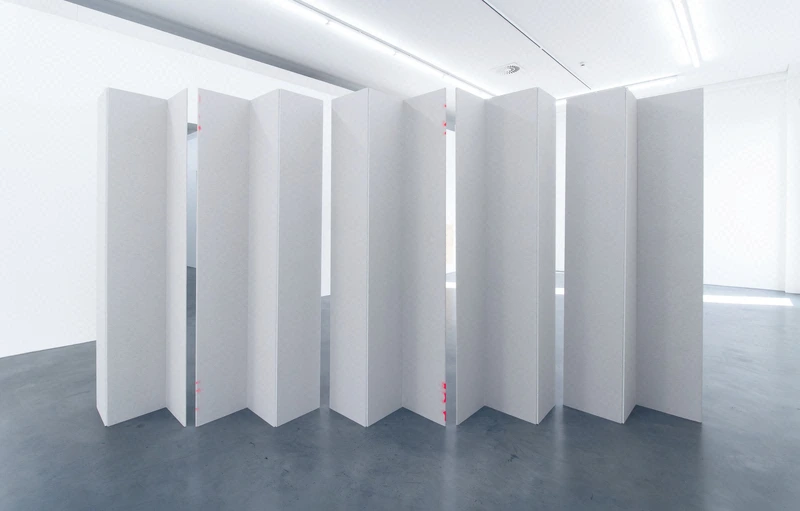
Dannenberg consistently reflects such overlaps in the choreography of his exhibition route too. A white wooden construction running along the floor, marked by a broad black brushstroke, defines a kind of protected space for two paintings by Marcia Hafif, before the installation crawls up the wall like a conveyor track in a logistics centre and disappears into the room beyond. There, columns assembled from fragments of grey concrete troughs from a DIY store lie as if on an ancient field of ruins. Their hollow sides, painted pink and turquoise, make five wonderfully luminous etchings by Robert Ryman shimmer in entirely unexpected hues. And in the central gallery, Dannenberg even had Richard Long’s substantial floor piece “Cod, Spring, Circle”, which has its regular place here, removed so that he could unfold a screen-like installation undisturbed in front of three delicate lithographs by Fred Sandback.
It is this mixture of respect and intimacy, reverence and appropriation that meets you at every turn in Dannenberg’s “Backspace”, inviting you to relax and hang out with him, the Judds, Rymans, Baumkötters and all the others. There is a great lightness in that.